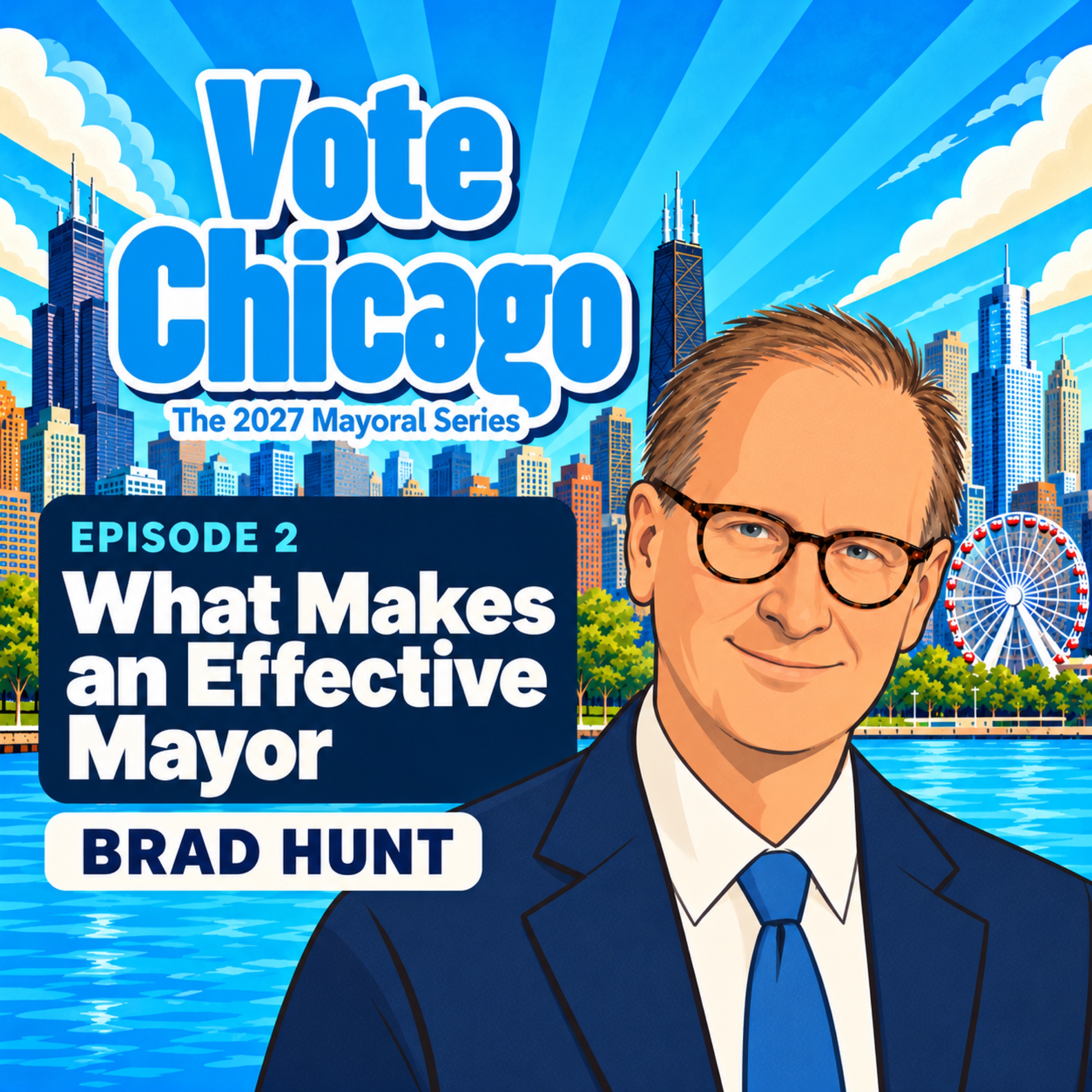
[00:00:00] Speaker A: Welcome to Vote Chicago, an independent, nonpartisan civic guide built for one purpose to help Chicago voters make a more informed decision in the 2027 mayoral election. Diving deep into the key issues facing Chicago today with experts that know them best, and sitting down with the candidates running for mayor to have direct, structured conversations about their plans for Chicago.
Everything here is designed to make sure you're ready at the ballot box. I'm Jesse Dadoski.
[00:00:30] Speaker B: And I'm Ashley Hartman. And we're looking forward to helping you get the information you need to Vote Chicago.
This program does not endorse any candidate and is not affiliated with any campaign, political party, government agency, or organization. All candidates we interview have been invited to participate under a standardized format. The views expressed by candidates are solely their own, and this program does not verify their accuracy. This is for informational purposes only. Please see our show notes for the full disclaimer.
Welcome back to Vote Chicago, an impartial, limited podcast series built for one purpose to help Chicago voters make a more informed decision in 2027.
I'm Ashlee Hartman, and my co host, Jesse Callahan and I are Chicagoans from the business community. Jesse in real estate, me in venture capital. And we started this series because we got frustrated watching serious challenges unfold in our city without a reliable place to get honest, clear information about them.
That frustration led us to start Working Title, a civic engagement initiative that's brought together Chicagoans from business, government, and philanthropy for candid conversations about Chicago's future.
This podcast grew out of that work.
You'll soon hear from the mayoral candidates directly on their vision for the future.
Before getting into the candidates, though, we want to lay the groundwork on what makes a good mayor and the key issues he or she will face. Because we think the lens you use to evaluate the candidates is critical to making the right evaluation of the candidates themselves.
What does it actually take to do this job?
What makes a good mayor? It sounds simple, but the more you dig into it, the more you realize how rarely voters stop to ask it directly.
We focus on positions, on promises, on personality. But the history of Chicago has a lot to say about what actually separates the ones who delivered from the ones who didn't.
To help us answer that, we sat down with Brad Hunt, chair of the History Department at Loyola University, to walk through the arc of Chicago mayoral leadership. Who succeeded, who failed, and why.
After the interview, Jesse and I will share a framework we've put together for thinking about mayoral leadership and for evaluating the candidates you'll be hearing from throughout the series.
Let's get into it.
April 1837.
Queen Victoria is weeks away from taking the throne. The global economy is about to fall apart.
Railroads and steamships are shrinking the world.
And on the muddy edge of Lake Michigan, a city of 4,000 people, wooden sidewalks and zero functioning sewers swears in its very first mayor, William Butler Ogden.
190 years later, that city now has 2.7 million people, a $16 billion budget, and a mayor's office that touches everything from the schools your kids attend to the roads you sit on in traffic every morning.
But here's the thing.
Understanding what makes a great mayor today requires understanding how the job has shifted throughout history.
And that's exactly what we're going to do in this episode.
I am thrilled to have Brad Hunt here, who's chair of the history department at Loyola University, who's going to walk through nearly two centuries of Chicago mayors and give us lessons about how to think about the role today.
Brad, welcome to Vote Chicago.
You have spent your career studying Chicago and its history.
Can you introduce yourself and tell us a little bit about how you ended up as our go to expert on Chicago mayors?
[00:04:16] Speaker C: Thanks, Ashley. Yes, I grew up in Chicago's west suburbs in the 1970s and 80s and then have lived here since 1998 doing history.
I've written on the history of public housing in Chicago and on the history of city planning in the post war period after 1945 in a book with my co author John B. DeVries called Planning Chicago. And so in that process of writing those books, the mayor is a central figure and teaching Chicago history, teaching American history.
We certainly had to wrestle with the importance of the mayor, its role, and how it's changed over time.
[00:05:01] Speaker B: I'm sure it certainly has changed if you start kind of at the beginning. Chicago's had 46 mayors over nearly 190 years at a high level. How has that job evolved from this very first mayor, William Butler Ogden, governing a frontier town of 4,000 people, to the mayor of America's third largest city today? You know, that role, I'm sure, has changed over the 190 years.
[00:05:25] Speaker C: I'm a historian. Let me take you to the 19th century. Let's do it. Not for too long, but Chicago's early, early mayors were actually weak mayors in that we created a weak mayor system in the 1837 charter for the city. That means that the mayor's real role was to head up the city council.
By 1851, the mayor had a veto over city council legislation, but other than that, there wasn't A lot of power. Most offices were elected or appointed by the city council. And so that weak mayor system is going to evolve over the 19th century.
The mayor was only elected for one year until the 1870s, and then it was a two year term. So this was not expected to be a role that would really govern or be a strong executive.
But in the 19th century, government wasn't doing that much. It was doing some regulation of markets.
It was making laws around things like alcohol. And this was a big issue in the 19th century. There was a riot in Chicago in 1855 when the mayor decided to close taverns on a Sunday and then jack up the liquor license by sixfold German immigrants.
[00:06:41] Speaker B: I would probably see a riot today if the same thing happened, but
[00:06:45] Speaker C: exactly. If we closed bars on Sunday and jacked the liquor license six fold, yes, you would have protests in the streets. And these were the big issues, particularly for a lot of the immigrant community. German immigrants were an important part of the city in the 1850s. But moving forward, city, the. The stronger, I'm sorry, the best mayors in the 19th century, none of them were truly strong in the sense of their power, but the best ones were boosters. They were basically trying to draw investment, trying to draw a great deal of attention to the city, sometimes without, you know, real ethics. But there were, you know, mayors that wanted to do, say, the 1893 Columbian Exposition. Carter Harrison.
There are actually two Carter Harrisons. It gets very complicated. And they served five terms each, but they were only two years. So, you know, but there are a lot of these booster mayors whose real role was to work with the business community and attract new businesses. Now that meant other things were going to get neglected. We were not particularly concerned about the welfare of immigrants.
The Catholic church did most of the social service delivery in the city in the 19th century. There were other things like orphanages and hospitals, but all those things were underdeveloped.
The school system was very underdeveloped as well in the 19th century.
That booster mode is going to change around the year 1900, late 1890s, early 1900s, with the progressive reform movement. If we remember our US history from high school, let's hope so.
The progressive movement really wants to clean up corruption. Chicago is a very corrupt city in the 1890s.
A strong city council system means that the city councilmen are also easily bought off.
They're going to be bought off in ways that are going to help build the L tracks around the loop. That was a giant corruption deal. But we're kind of happy we have tracks Downtown.
But the corruption was a big issue.
The progressive movement and progressives in Chicago tried to create a new charter. They tried three times. 1907, 1909, 1914. We need to reduce the power of the city council, increase the power of the mayor. They're going to lose. But Slowly, in the 20th century, the power of the mayor is going to increase in part through the political skills of the Democratic party in the city.
Before we go on to maybe the machine, I wanted to add the last Republican mayor of this city was Big Bill Thompson. All right, now, Big Bill Thompson's a crazy guy. He's kind of a lot like our current president in some ways. He's bombastic. He's a demagogue.
He's a really creative and crazy campaigner. He has like parade of elephants down the streets. He walks around campaigning with a cage with two rats who he names after his opponents. Things like this, you know, real stunt man. He attacks the press aggressively.
Yeah. He's also way into graft and corruption in a way that's shocking even by today's standards.
He is really good at challenging the business community and institutions and calling them out of touch.
And he wins three times.
And the papers are outraged, the reformers are outraged, but the people elect him, and eventually the corruption becomes way too much. He's two in bed with Al Capone.
When he dies, they open his safe deposit boxes and he has 1.8 million stashed in like, half a dozen safe deposit boxes. That's a lot of money in 1933 or 1944. Excuse me, when he dies. So bad guy. But the people liked him and the people elected him.
And so that kind of charlatan mayor did nothing, though, for advancing key agendas of the city, whether it's building a social safety net, education, these kinds of things.
You know, he was a showman.
We can turn to the machine.
[00:11:13] Speaker B: Yeah. Tell me how the mayor starts to kind of get more control over the city. That would be extraordinarily interesting to kind of take this arc to its conclusion.
[00:11:22] Speaker C: Thank you. Yes. Okay, so Big Bill Thompson, the last Republican mayor, loses in 1931 to Anton Cermak. He loses in part because he gets anti immigrant, which is a bad move in Chicago in 1931.
So Cermak is a Czech immigrant, brags to Rich's story. He is a part of the Democratic Party, and he really starts to build a multi ethnic Democratic party during the New Deal.
It helps that he's also pretty good at running things. It also helps that the federal government is going to start pouring money into the city later in the New Deal.
And it helps that he's made alliances with the Polish community, the Irish community, the Czech community, the German, you know, these various ethnic groups in an ethnic coalition.
He's going to die in 1933. He's going to get shot in an assassination attempt on President Franklin Roosevelt just before Roosevelt gets inaugurated in Miami.
The bullet misses Roosevelt, hits Cermak, kills him. It's all very tragic, but Cermak lays the groundwork for the Democratic Party machine that really Mayor Ed Kelly is going to build between 1933 and 1947. And it's built on patronage jobs for Democratic party workers. And there are a lot of jobs now that the New Deal has expanded things. We're starting to build new, build more roads, build some housing, a lot more construction. And during the war years in particular.
So unions are going to be on board with the mayor in a way they weren't with Bill Thompson.
He's also going to distribute, think very strategically about distributing the senior positions of the city to a broad ethnic coalition of Irish, Eastern European, and to some extent the Italian community.
And this is going to create a really solid Democratic party that's going to last through really the 1980s, late 1970s.
[00:13:31] Speaker B: And was the purpose like, was this an active, like, hey, I'm an executive and I want to have more control or was that the outcome of this process?
[00:13:39] Speaker C: That's the outcome. Thank you. That's a really important point. So when you start appointing people who are loyal to you into these positions and you ask them to do something, they're more likely to respond.
Progressive reformers had wanted these to be not tied to political patronage. And this is a long running debate among historians.
Is it better to have a patronage system where the workers respond to the boss or an independent system which the mayor can't control? It's long standing tension. The reality is you want a little of both. You need some independent commissions, but you also need that if the alderman calls up and says, hey, that trash wasn't picked up, and if you don't do it, this is going to be a big deal because I'm going to lose an election. That accountability in a patronage job can be effective. But political scientists, historians have been debating this forever. We're now still
[00:14:29] Speaker B: today.
[00:14:29] Speaker C: I mean,
[00:14:30] Speaker B: we have this issue.
[00:14:31] Speaker C: Yes. And we're now in this mode of patronage is bad and we need to have a reform government with civil service protections and then get the administrators to get it right.
It's not an easy Balance in some respects, if you want to be mayor and you want something to happen and you don't control the office, you don't get your way.
Big issue in the schools. Big issue in the Chicago Housing Authority day. Big issue like who's going to be in charge. Power.
That's at a big level. Sorry, I got a little carried away there.
[00:15:12] Speaker B: No, no, no. We love
[00:15:13] Speaker C: the.
The machine becomes really powerful under Richard J. Daly. All right. I really love these mayors. So I want to back up and give a little more history. I talked About Ed Kelly, 1933-1947, an Irish guy, He builds this machine. It's pretty corrupt, but he also has this good governance side. So he realizes I can't just be corrupt all the time. I've got to appeal to this progressive wing. And so he does do progressive New Deal things when he can.
And so he embraces the Chicago Housing authority, which in 1937 was thought to be a great reform. He embraces education reform, these things that he embraces the black community to some extent.
So much so that he's going to lose the election. He's going to get forced out by some of the aldermen. Race is going to be a big issue in mid century Chicago.
After Kelly, Mayor Kennelly comes along. He's a prop of the machine and the business community is kind of happy with him, but nobody really likes him. He's just not a likable guy. Richard J. Daly comes in, everybody likes him. Not as the back slapping guy you want to hang out with, but as somebody who's smart, who you can work with, who is really connected in the Democratic machine, but also wants to do right in a broad sense, not in maybe a 21st century do right sense. But he wants a well run city and he really wants experts.
So, yes, the guy picking up the trash is going to be our guy in the machine, but the city planner or the head of the finance, those are going to be experts. And so he has this blend of expertise and patronage that really worked for much of his mayorality until the end when people just took advantage of him.
[00:17:20] Speaker B: Yeah, no, I mean,
[00:17:21] Speaker C: that's a lot. Sorry.
[00:17:21] Speaker B: No, this is fantastic. I mean, all these stories are so helpful because it does ground how much history rhymes.
First of all, you know, we kind of see a lot of the dynamics kind of playing out today, even though we think these are new and novel things that we're dealing with as contemporaries, but they really do have.
And I think the second thing you're pointing out is how different Personalities and mayors can govern differently and have wildly different results and set kind of that momentum for the future on, you know, how Chicago will be a decade from now, even though, you know, you don't realize that kind of when they're starting their overall term. Right. Yes.
[00:18:01] Speaker C: That these investments take time.
[00:18:03] Speaker B: Totally. Totally. And you can only really analyze it like you do as a historian.
And I think you're kind of pointing to this, you know, talking about the patronage model and the Democratic machine, that the mayor doesn't govern alone. They've got to work with city council, you've got to work with the aldermen, you have to work with Springfield, you have to work with the federal government.
How has that kind of web of relationships shifted over history and, you know, to where we are kind of today? And what is that dynamic that we should kind of pay attention to?
[00:18:31] Speaker C: Really important. Thank you. Great question.
And so, again, I'll go back to the 19th century. Chicago was first a port city and then a railroad city.
The port was dredged by the federal government. So without that federal money to actually make the port functioning, Chicago might not have been the center of attention. St. Joseph, which also had kind of a link with. If you made a canal, St. Joseph, Michigan could have been. Or Green Bay could have been. There were other possibilities for a metropolis in the Midwest, but the engineers chose Chicago, which did have some advantages. So let's fast forward to, say, the New Deal. I just talked about Mayor Ed Kelly, but also Richard M. Daley. Richard. Excuse me, Richard J. Daly. Richard J. Daly. Richard Daley. I.
He was extremely effective in working both with Springfield. He had been a state senator. He knew everybody in Springfield and in Washington. Early on, he becomes the head of the mayor's conference, which is like the group of mayors who lobby Washington.
And so what does Richard J. Daly get? Early on? He gets legislative changes in Springfield that he wants in order to have a stronger mayor in Chicago. It's not a full council, not a charter reform, but it's incremental things. And then he gets a lot of money from the federal government in the 1950s to build things, some of which were very good, like the water treatment plants.
We have massive water treatment plants off the lake. That's Richard J. Daly. And also things that didn't work so well, like public housing, those large high rises.
But he got the highways built now. The highways plowed through neighborhoods, but where we would be today without some of those highways.
So there's this balance. He's very good at, at working at those multiple levels of government because he's got connections, because he's a leader. He's perceived as a leader nationally by other mayors. And people in Washington listen to him. They have him in constantly to testify.
He's not particularly eloquent, but he makes the points he wants.
[00:20:45] Speaker B: And so if we kind of.
Where do mayors sit today on kind of how they need to navigate it? Is it any different than it has been in the past, or do you think it's just the same and it just depends on who you elect?
[00:20:57] Speaker C: Yes, that's a really good question. So many of the more recent mayors. So let's look at some more recent mayors, and I want to turn to people like Rahm Emanuel. Rahm Emanuel, extremely well connected in Washington, extremely well connected in the business community, was pretty effective at that. Politics less effective at ward level politics less effective at, say, how do I manage a police force that's a little out of control in some ways, that just hasn't really modernized in the way other police forces had?
He's not going to be as effective at that. He doesn't have a power base in the communities with a machine behind him that looks up to the mayor. Whereas Richard J. Daly had that if a police officer got way out of line, the mayor could talk to the alderman, who'd talk to the committeeman, who'd talk to the precinct, and, you know, and they would all have to kind of now. It was never perfect. It was a mess. There were parts of things that weren't good at all. Not going to defend Richard Jay Daly's overt racism, for example.
But there was a little more accountability, that accountability thing.
And the current mayor has real struggles beyond the school system at imposing his desires. And you just see that in the budget, in the housing authority, for instance, in these places. He really wants to exert authority and he's struggling.
[00:22:42] Speaker B: Yeah, it really sounds like it's just hard to find any one person who's going to have all these relationships that they can pull on. Right. Some are going to be stronger in some areas than others. Not just, you know, not every person's going to be, you know, the savior of, you know, every relationship in the city.
[00:22:58] Speaker C: And this played out particular. That's a good point. This plays out particularly strongly during the mayoral mayorality of Jane Byrne.
Jane Byrne 1979-1983 she gets elected as something of reformer, anti machine. The machine couldn't get the snow off the streets and people were fed up with the machine. Post Richard J. Daly, it was in a little bit of disarray Jane Byrne comes up with a surprising victory. She had been grown up in the machine, but she runs against it. She gets into office and she's not sure which way to go. Do I try to co op the machine, excuse me, co opt the machine and really sink my political roots with them and try to win them over, or do I go with these reformers and say the heck with the machine and I'm going to go my own way? And she can't decide. She goes back and forth on some issues, she tries to go with the machine, some issues, she goes with the four, and nobody's happy.
And it turns into a really not a strong, not effective mayoral time for her. And so she one point says she's going to appoint reformer.
The Chicago Housing Authority board had been all white and she was supposed to appoint some black representatives. And then she waffles and appoints two more white representatives. And so the black community's outraged. The machine's not entirely happy and nobody's happy. It's like politics is hard. Running these cities is hard.
[00:24:38] Speaker B: Yeah. Not for the faint of heart. It's not an easy job. Probably leave with a lot more gray hairs than you came in.
So taking a step back, you've come up. You shared so many incredible examples of Bayers throughout history in Chicago.
When you look across kind of 190 years of mayors kind of taking a higher level view, what separates the ones who are successful from the ones who fall short? What are the patterns we can point to? And I think I can point to some patterns from what you've shared with us already, but
[00:25:11] Speaker C: building on that last answer, I think the ones that can establish a political base that's not too narrow and not too beholden to.
Right. So Richard J. Daly becomes, you know, he's got this strong power base from the machine, and it means he can upset small parts of the machine, but the big machine's going to hold together.
That's a diffuse, broad power base for him. He also has labor unions. He's also very keen on keeping labor unions inside the Democratic coalition and gives them large raises that are going to long run, kind of come back to bite us, but a strong connection there. So he's got this diffused power base. If something goes wrong, the thing's not going to collapse.
Someone like Mayor Lori Lightfoot comes in with zero power base. I mean, she was a federal prosecutor.
Nobody's really worked for Laurie or feels like they owe some allegiance to Lori Lightfoot when she was mayor. And that made it extremely Difficult to govern.
Someone like Harold Washington was very effective at creating a multi ethnic coalition along the lines of people like Cermak and Ed Kelly back in the 30s and 40s that could govern that. Even though there were massive opposition from white aldermen during this council wars, excuse me, the council wars of the 80s when white alderman opposed anything the mayor wanted to do.
But he still could implement certain things as mayor because he had the support of a lot of the neighborhoods.
So a broader, diffuse power base is better than a narrow one.
And I think that's where.
How do you build those coalitions?
Richard M. Daly, son of Richard J. Inherits in some ways the allegiance of enough of the Democratic Party to run, not the old school machine. Where you need a job, we'll get you a job. Now your allegiance is to me, it was much more of we're going to work hard to distribute the benefits of government as diffusely as possible. So he's going to work with the black community, the Latino community, in really making sure that the city is at least in part more equitable, even as he's investing a lot downtown. That downtown neighborhood tension is a big one in the past. Now I'm rambling a bit off the. You're
[00:27:56] Speaker B: rambling with incredibly instructive examples.
Just let's turn to mistakes for a couple minutes. So every mayor makes mistakes. There's some whoppers and then there's some smaller mistakes. What are some of the most instructive failures you've seen and what can they tell us about some of the pitfalls of this job?
[00:28:14] Speaker C: Yeah, the classic example is Mayor Bilandic 1979. The snowfall couldn't get the snow off the streets.
And ever since, people have really been good at getting the snow off the streets. We have not had that problem getting the city services. Right.
That was a big mistake. I would point to Rahm Emanuel, who had a really solid mayoralship until they couldn't handle the Laquan McDonald murder.
Throughout Chicago history, these single events can often pivot, you know, can, can pivot mayoralships. And that one certainly was as strong as any. He went from somebody that people trusted to somebody that people didn't trust. And so how do you handle a crisis is a big one.
And I think, yeah, Rahm thought he knew how to handle it and tried to play it and he lost. I mean, I think even he. I don't know if he would admit that. That'd be a good question. He would be a very interesting guest for your podcast if you can get it I
[00:29:25] Speaker B: agree, I agree.
And as you're kind of pointing to though, this job is full of so, so many trade offs. And we're going to talk a lot on our podcast about tensions and trade offs. Do you invest downtown? Do you invest in the neighborhoods? Do you raise taxes? Do you lower taxes to spur growth? Do you go to Springfield to try to keep them happy? Or do you advocate and be kind of a warrior for Chicago interests?
How have mayors historically navigated these tensions? And what have you seen be successful versus not?
[00:29:56] Speaker C: Yes, again, Richard J. Daly. Very successful at navigating both Springfield, Washington and the city bureaucracies.
I think historically, particularly in the 50s, 60s and 70s, the federal government was a bigger player, really was pouring a lot of money into cities.
We had urban unrests.
This is where Richard J. Daly had that moment and kind of fell down that in 1968, where he sicks the police on the protesters at the Democratic National Convention. He has that shoot to kill order during the riots. All mistakes that are going to be the beginning of the end.
How do you handle that crisis? But back to the bigger question, like, yeah, how do you navigate these tensions?
This is, this is the heart of the matter, you know, like taxation, nobody wants to FC taxes go up. How are they balanced over time? We've had commercial taxes have been rising faster than residential taxes. And so the business sector is really feeling not happy. But it's really got to be about growth.
The one way around all this is just grow.
And Richard J. Daly figured that out. Richard M. Daly and Rahm really figured that out. We've got to turn, you know, bring, attract the business community.
And Chicago became a global city by 2000. Millennium park opens 2004.
I remember that well. And for four years, everybody said, what is this hole in the ground? Why this thing is so expensive? What are we doing? And then it opens and everybody's like, wow, this is great.
Everybody forgot the $400 million price tag. Right?
They both.
So Richard J. To some extent, Rahm had strong visions for attracting, attracting new businesses that are going to grow the pie rather than worrying about how we're going to slice up a fixed pie. And that's essential.
[00:31:55] Speaker B: You're pointing to kind of a positive feedback cycle rather than kind of a negative feedback cycle. Right. And like just making sure that you're focused on kind of the future. And the growth of the city needs to be somewhat equally shared too.
Not just growth for all costs.
[00:32:11] Speaker C: Exactly. But I, I, I'm now remembering a, a whopper of a mistake that gets to this problem, like Richard M. Daly in I. I'm forgetting the year in the early 2000s did the parking meter deal.
Now, there were actually two deals.
[00:32:28] Speaker B: We all know about that one.
[00:32:29] Speaker C: We do all know about that. Well, there are actually two deals. First deal is to sell the skyway. The bridge leads south. That was a very good deal. And we made a lot of money. And he got kind of confident about, yeah, I can do these deals and we can bring in money. And then the parking meter deal. So he has one victory and he's all flush with victory and he turns to the second one. And that turned out to be a really not a good deal.
And we squandered a whole lot of revenue.
Not an enormous amount, but a significant amount of revenue and lost some of the control of our streets. It's now expensive, more expensive than it would be to, say, redo some streets that are more pedestrian friendly, things like that.
Not a good deal. And so good mayors can do both. Make bad deals.
[00:33:19] Speaker B: Yeah. There's also a bad narrative, too. It's not just the deal, it's the narrative that's come with that.
Okay, I have to ask, who's your favorite mayor and why?
[00:33:28] Speaker C: Who's my favorite mayor? Okay, so can I hedge on this and give you two favorite mayors?
[00:33:33] Speaker B: Go for it.
[00:33:35] Speaker C: We haven't talked enough about Mayor Harold Washington, who gets elected in part because of the fracturing of the Democratic Party around 1983 when Richard M. Daley and Jane Byrne are going to kind of split a vote and Harold Washington's going to win. But he was very effective.
And again, this kind of coalition politics, he actually had some great initiatives that nobody really talks about. One are these planned manufacturing districts. He said, we've got to keep some working class jobs in the city. We've got all this land that's been abandoned, but we're going to protect it and make it attractive to new industries.
That policy is going to be continued very effectively by Richard M. Daly. Richard M. Daly runs Washington was terrible, terrible. But then he gets in and he's like, yeah, that was a good policy.
And that has kept things like the ford plant at 130th in Torrance.
There's a lot of light manufacturing that occurs in the city and logistics things and other essentials for a city that have benefited from that policy.
You know, it was a chaotic mayoral ship because of the conflict in the city council.
But I think he had a good long run vision of a multi ethnic city that invested both in downtown and the neighborhoods he was just shifting away from downtown.
Now, I've also been a big advocate for investing in downtown, but not in the ways we're currently doing it.
So my second favorite mayor, and this one's going to be more controversial to my colleagues, I guess, is Richard J. Daly. The first, again, said some awful things, gets 1968 all wrong. But that first 1955 to 1965 period, his first three terms, really, he was really good at both balancing the machine and balancing that expertise that I mentioned he was hiring guys away from. He's like, who's the best at this? Who's the best at this? And he would hire them away from other cities and bring talent to Chicago. He also said we got to preserve downtown as the core. We cannot move our core downtown functions out of the Loop to, say, North Michigan Avenue, which people were proposing, because we got to get away from the black community. Race is central to all these stories.
We can't. You know, he said, we're going to invest in downtown. So he puts the Federal center downtown. He puts the Daily center downtown. These government buildings to anchor the Loop. He gets First national bank to invest and build that. Now the Chase Tower with the Chagall thing, that's all being restored. Downtown gets saved under Richard J. Daly, and he's also able to invest in the neighborhoods. He creates a capital plan.
The problem of Richard.
See, now I'm coming back off to your question of what's my favorite mayor? Yeah, I just admire Richard J's first two, three terms for his ability to save Chicago at a time when Detroit, St. Louis, Cleveland all go downhill at the same time.
It's really going to be immigrants who are going to arrive in the 70s and 80s that are going to save Chicago from that deindustrialization moment.
Richard Jay didn't care that much about immigration. It's going to be Harold Washington and to a lesser extent, people like Rahm Emanuel are going to care about those immigrant communities and embrace that as an important part of Chicago, because where would we be if we didn't have that Latino migration into, say, a little village which is a thriving community? Got lots of problems, but it's not abandoned in the same way other parts of the city are.
[00:37:30] Speaker B: No, that's so helpful. And I mean, as a historian, I'm sure you have a lot of examples to pull from.
Okay, absolute last question. In your opinion, both as a citizen and a historian, what makes a good mayor of Chicago?
[00:37:42] Speaker C: Yeah, what makes a good mayor?
We haven't talked about communication, Rich. None of these mayors have Been particularly eloquent. Except maybe Rahm, who's just a super smart guy.
Yeah. How do you communicate? How do you be a person of the people and yet still be very good at attracting talent? And that's where I'm interested. Interested, like who's going to draw people to Chicago?
Both immigrants who are struggling, but in two generations will help be the core of the middle class and global talent. We're in a global environment.
We're a global city now. We need to sustain that so we don't become Detroit, a city that's hollowed out, that once was a international center for the auto industry. It was too dependent on one industry.
So, yeah, that charisma factor matters, I think.
But also an ability to build coalitions to get things done. I was actually going to
[00:38:56] Speaker B: say those two are so interrelated. Right. Communication and coalition building are very interconnected. They don't have to be. But, you know, if you are good at communication and coalition building, you can really do a lot for the city.
[00:39:08] Speaker C: Yeah.
[00:39:10] Speaker B: Brad, this has been fantastic. Thank you so much for joining us. I'm leaving with such a sharper picture of how we've gone through the journey of Chicago mayors that I'm incredibly educated and I just appreciate your walking us through that.
[00:39:25] Speaker C: Thank you.
It was high level and yes, we could spend hours.
[00:39:29] Speaker B: Well, we can dive deeper in future episodes, so thank you so much.
That was Brad Hunt, chair of the History Department at Loyola University.
If you want to go deeper on any of the mayors or moments he mentioned, we'll have links and reading recommendations in the show notes.
One thing that kept coming up in our conversation and honestly, in all the research we did for this episode, is that the best mayors aren't necessarily the most charismatic or the most ambitious. They're the ones who understand what the job actually required of them at that moment in time.
So as we head into this election, we wanted to give you a concrete way to think about that.
What does this job require and how do you evaluate whether a candidate is ready to deliver on it?
Jesse's now in the studio with me. Hi. And we have been talking through this question using just a framework we've been thinking about and just wanted to walk everyone else through it. So, Jesse, maybe you can start and give us a high level around the framework.
[00:40:27] Speaker A: Yeah. And just to caveat, this is our framework. It's something we thought would be helpful.
Maybe there are parts of it that we think are right, maybe wrong. Up to you to decide. But we just wanted to give a general framework so We've been kind of thinking about what makes a good mayor as a pyramid. Almost like Maslow's hierarchy of needs, you somewhat have to master the lower parts of the pyramid before you make your way up.
And only a handful of mayors might be able to reach kind of that final stage. But every mayor is judged on whether they're able to deliver that foundation.
And as you move up in the pyramid, the impact of the city should get bigger. But if you don't get the base right, none of it above really matters.
Here's the thing. It's not necessarily a pyramid or a ladder that you have to climb rung by rung. From the moment a mayor takes office, they're really judged on all four levels simultaneously. But what the pyramid really tells you is how forgiving voters are at each level.
If you miss the top, people are going to debate your legacy. And if you miss the bottom, you're kind of done right for reelection.
[00:41:32] Speaker B: Yeah, no, I mean, I think of it. I'm in the food industry and so I think about it kind of like running a restaurant, right? Like you want the ambiance to be great, you want your waitstaff to be attentive, and the ultimate goal is you want to be on every best of list. But if your food isn't good or you don't even deliver the food, it really doesn't matter what any of the rest of it is going on in that restaurant.
[00:41:55] Speaker A: That's right. So before we get into it, I'm also going to caveat that this framework. Caveat the framework with this idea that there are always trade offs too.
As we talked about, there are definitely examples of, as we will talk about, there's definitely examples of getting things done that have been at the expense of equity and inclusion and fairness and that shouldn't be overlooked. And I think equity imbalance is certainly something we need to be referencing and reflecting on as a city. And more than that, definitely embedding into our plans and impact reporting as we talk about progress in the city.
[00:42:29] Speaker B: 100%.
So let's get into it.
[00:42:32] Speaker A: Yeah, sure.
[00:42:34] Speaker B: So we're starting the pyramid with level one, which we are calling base services.
Before a mayor could talk about their vision or their legacy or their growth, they have to answer a few simple questions. Not easy, but simple. Is the trash getting picked up? Are the streets clean? Are the schools open? And do your residents feel safe?
These just aren't aspirations. They're the base floor of what you need to achieve. If you're a mayor of Chicago, if you can't deliver here. Just nothing else is going to matter.
[00:43:05] Speaker A: Yeah, so true. So Chicago has seen what happens when a mayor fails at this level. And it's not pretty. William Hale Thompson served as a mayor in Chicago for 12 non consecutive years in the early 20th century. And by almost any measure, he's Chicago's cleanest example, clearest example of a level one failure.
During his tenure, police corruption was really rampant. Al Capone thrived in the city during this time, gang violence exploded.
The city's most basic obligation to its residents is really to keep people safe. And, and this didn't happen at this time in Chicago. That safety net really collapsed and Chicago's national reputation collapsed with it.
So Thompson's a cautionary tale. We also heard Brad Hunt talk about Mayor Michael Blandick and the Snow disaster in 1979. So that's another reference of people really point to that snow disaster, the lack of his management of that as the reason why he didn't get reelected.
It's definitely not always easy to get base services right, but it is really a requirement of the job
[00:44:09] Speaker B: 100%. And it just doesn't earn you the right to move up to the next level of the pyramid if you don't get that right.
And so Jesse had pointed out kind of one caveat we need to keep kind of running through this pyramid is that who receives the services matters as well as if they're delivered at all. Because a city where trash is picked up in one neighborhood but not another, or police come to the north side and not the south side, it really hasn't delivered on level one. You have to. It's only delivered for some people at some time. So we really have to think about kind of base level for everybody.
[00:44:44] Speaker A: That's right.
[00:44:45] Speaker B: So moving on to level two. Level two is where a mayor can prove that they are going to govern, but not alone, but with others.
And so Brad talked a lot about this and kind of the history and how you are building those coalitions. But you know, you've got to build coalitions across city council, across communities, across institutions in Springfield and certainly Washington as well. And so the core skill is like, here is really getting alignment across different types of interests and different communities and different stakeholders and pointing them in the same direction long enough to actually accomplish something. So level two in our mind is building and sustaining coalitions.
[00:45:24] Speaker A: Yeah. So a mayor who clearly exhibited level two is Richard J. Daly. And Brad spent a while talking about the activities during the J. Daly tenure as mayor. So we're talking about level two, but with regard to level one, Daley really delivered the base services flawlessly and consistently. Streets were plowed, trash was collected, police and fire showed up. The city ran with just this mechanical reliability. You could argue with his politics, his ethics, or his methods, but Chicago did run like clockwork. And he understood that before a mayor can inspire reform or innovate, he really had to make sure the city functions. So that cleared the way for him to focus on level two.
And this is really where he shone. His ability to build and sustain coalitions worked in part because he had also served as the local Democratic party leader.
That centralized authority really had its perks. He let the aldermen run their wards like executives, and in exchange, they were really deferential on citywide issues, which was very helpful to have that mayoral power.
Again, you can argue with his politics in the system, but it did allow this path to execute on larger projects. And one of the examples of those larger projects was the Dan Ryan Expressway.
So in the early 1960s, Daley's office aligned planning, transportation, streets and sanitation, police, fire and city council. Before ground was broken, routes were finalized, land acquisition was cleared, traffic plans were coordinated. Aldermen whose wards would be disrupted were brought in early and compensated with improvements elsewhere. So we really aligned everyone to move this forward. And then there were also federal partners who were funding a lot of the project, and he had those connections as well to align them on this project.
So by the time the project reached city council for a vote, the votes were counted, the funding was locked, the departments were ready to execute major sections of the Dan Ryan rose in roughly one to two years, which you think about some of the bridges in Chicago that are under construction now that are going to take three years. So that's really a huge accomplishment. And it opened in 1962. It was just constructed exceptionally fast forward for a dense urban expressway of its scale.
[00:47:44] Speaker B: But that does bring up this kind of caveat through line that we've been pushing through every level of the pyramid. In that Daley was able to really absorb all conflict privately and deliver publicly. And he turned what could have been paralysis into full on execution, which is super impressive. But that coalition building left out a significant populace in Chicago because the Dan Ryan's routing displaced thousandstends of thousands, really of residents, disproportionately black Chicagoans, who, you know, this was later understood that that was part of the plan was this actual racial segregation. So of course the project didn't stall. And we have the Dan Ryan that's been extraordinarily helpful to our city. But the communities that bore its costs had no seat at the table to even have a voice. And that coalition, you know, even though it excludes, includes citywide initiatives if it excludes the people most effective, it's certainly a moral failure, but it tends to produce decisions that haunt cities for generations. So there's really just a lot of trade offs and tensions we have to tease out in every decision here.
[00:48:51] Speaker A: Yeah, that's so right. Level two is not just can you align institutions? It's whose voices are in the room when you do
[00:48:57] Speaker B: 100%. And so now we get to the third level of our pyramid, which is driving growth.
So level three is where a mayor has to leave the city stronger than where we found it.
And so Brad also talked about kind of, you know, really driving growth for the city. And that papers over a lot of other issues, which is good in some senses. But growth, as we've been talking about, has to be defined carefully because the numbers can look good while on average, but a lot of people can be left out. So real growth to us means that jobs are forming, revenues are flowing, and neighborhoods across the city are participating.
And it also means that the city's long term fiscal house is in order because a mayor can drive growth today by ignoring pension obligations and deferring infrastructure investment. But that's just really borrowing from the next administration.
[00:49:47] Speaker A: Yeah. So two modern Chicago mayors really stand out. Richard m. Daley and Rahm Emanuel. So starting with Daly the younger, he served for 22 years from 1989 to 2011, and he's widely credited with turning Chicago into a modern global city.
Millennium park was a significant achievement of his and his signature achievement, really. When you look at the data closely, the picture is mixed. Population declined slightly during this time, from about 2.71 million to 2.68 million. And inflation adjusted, per capita income grew. But it did lag the national average roughly 19% versus 26% nationally.
And critically, Chicago's pension obligations ballooned drama dramatically during his tenure, A fiscal time bomb that his successors are still trying to diffuse. So then we have Rahm Emanuel. The initial data looks stronger for Rahm on growth metrics. From 2011 to 2019, Chicago's real per capita income grew at 3% annually, compared with roughly 2% nationally. He aggressively recruited and retained major employers. This is when McDonald's landed their global headquarters here.
He expanded Google's footprint. He kept firms like United Airlines anchored in the city.
He pushed infrastructure tied to growth, modernized transit, rebuilt o' Hare and bet early on tech Corridors that really did position Chicago as a credible alternative to the coast. That being said, there are certainly reasons to critique Emanuel's tenure. Some say his growth was at the cost of. Of the focus on the south and the west sides. Brad Hunt alluded to the fact that he wasn't really in the neighborhoods and didn't really have support of certain neighborhoods. And then there were some policing issues, for sure. So he certainly didn't solve every problem. But at level three, driving growth, he was focused aggressively, and the headline numbers show that he was effective.
[00:51:45] Speaker B: Yeah. And that brings us down to the top of the pyramid, which is kind of the accumulation of all three levels.
When we get to the last level, level four, we're calling it inspiring others.
And we want to be precise about what that actually means because, you know, it's easy to describe it as, quote, inspiration and leave it vague. But what separates mayors at this level isn't charisma only. It's that they articulate a compelling, specific vision of what the city can become, and then they execute against it publicly enough that residents feel like participants, not just spectators.
[00:52:20] Speaker A: Right. Mayors that have the ability to take on this level really become the city's CEO and chief marketing officer. Their messaging and their evidence of walking the talk does help them recruit companies, build parks, and throw out first pitches at Wrigley and make playful wagers with Detroit when the Bears play the Lions.
They become really inseparable, these mayors, from the city's identity during their tenure and than often long after.
[00:52:46] Speaker B: Yeah, I think it's like that chief marketing officer, that narrative around Chicago is so important, almost as important as what's going on in the city today.
And we can debate whether any mayor has ever achieved this level or what mayors you think are actually have achieved this level. But other cities are offering some recent examples that we're excited to see if they do stand the test of history. Because we don't know yet.
[00:53:08] Speaker A: Right.
Yeah. So in terms of other cities that offer some recent examples, in New York, Mayor Bloomberg reshaped the city through fiscal discipline, public health reform, and technocratic management. And he gave the city a coherent identity as a place that really did take governance seriously. And then there's Francis Suarez in Miami. He capitalized on crypto and remote work momentum to really rebrand Miami as open for business early in his tenure. But Daniel Lurie in San Francisco appears to be off to a strong start. Start by really focusing on safety and riding the AI wave.
[00:53:44] Speaker B: Yeah. And what those mayors are sharing is not just this personality. It's that they bet on what their city could become. And then they drove everything around government in a way, in that way that made it feel real. So they really delivered on all other parts of the pyramid in order to kind of reach this level. Four, inspiring others.
[00:54:06] Speaker A: Yeah. And the best of them really do it in a way that makes the city.
It feels like the city vision belongs to everyone. That's the full pyramid. And so that's what we're going to be looking for in this upcoming race.
[00:54:17] Speaker B: Yeah. I hope we find a candidate in the 2027 mayoral election that is able to.
[00:54:22] Speaker A: That's the ability to fulfill that fourth rung.
[00:54:25] Speaker B: Exactly.
And so, you know, pulling all this together, what all these mayors strive to do is the same.
They want to deliver base services. They want to build and sustain coalitions. They want to drive growth and then inspire others.
They take advantage of what the city already has, and then they build on it. So that's what makes a good mayor to us. And that's what Chicago really needs now. The fiscal burden here is as daunting as our winters, but Chicago also sits at the center of America's logistics network. We're surrounded by elite universities, and we have infrastructure that gives our city as strong a platform as any other in the country.
The question isn't whether Chicago can work. It's whether we choose leaders who know how to make it work and have the ability to deliver on all levels of that pyramid.
So thank you for joining us for this episode. We hope today gave you a sharper framework on what to listen for when the candidates start making their pitches to you.
If this episode was useful to you, please share it with someone in your life who wants to be a more informed Chicago voter. That's exactly who this show is for, and we'll see you next time. Vote Chicago 2027 is an independent publication and podcast. This program is not affiliated with, sponsored by, endorsed by, or connected to any political campaign, political party, political action committee, super pac, government agency, or any other organization. Any similarity in name to any other organization is not intended to imply any affiliation, endorsement, or connection. This program does not endorse, support, oppose, or recommend any candidate to for the 2027 mayoral election or any other public office. The publication of a candidate's interview does not constitute an endorsement of that candidate. A candidate's participation does not constitute their endorsement of this program. All declared and qualified candidates for the 2027 Chicago mayoral election have been or will be invited to participate. Interviews are conducted using a standardized format to ensure fairness and equal treatment. If a candidate has not yet appeared, the invitation remains open. The views, opinions, claims and statements expressed by candidates are solely their own. This program does not verify, fact check or vouch for the accuracy, truthfulness, or completeness of any candidate's statements. Listeners and readers are encouraged to conduct their own research and consult multiple sources before making voting decisions. This program is produced for informational, educational purposes only. Nothing herein constitutes political advice, legal advice, financial advice, or recommendation to take or refrain from taking any action. The copyright for this program is held by 2026 Chicago Syndico, LLC. All rights reserved. All content, including text, video, audio, graphics and logos, is the property of the producer and is protected by US International copyright laws. Unauthorized reproduction, distribution or use is prohibited without prior written consent to the fullest extent permitted by law. This program, its producers, hosts, employees, agents and affiliates should not be liable for any direct, indirect, incidental, consequential, special or punitive damages arising out of any or related to the use of this website, podcast, or any content therein, including any reliance on statements made by candidates.
This disclaimer Any disputes arising from the use of this website or podcast shall be governed by the State of Illinois. Exclusive jurisdiction and venue shall lie in the State or federal courts located in Cook County, Illinois. For more information about voter registration, polling locations and how to participate in the 2027 Chicago Mayo election, please contact the Chicago Board of election
[email protected] for questions, concerns or legal inquiries, please contact votechicagousubstack.com.