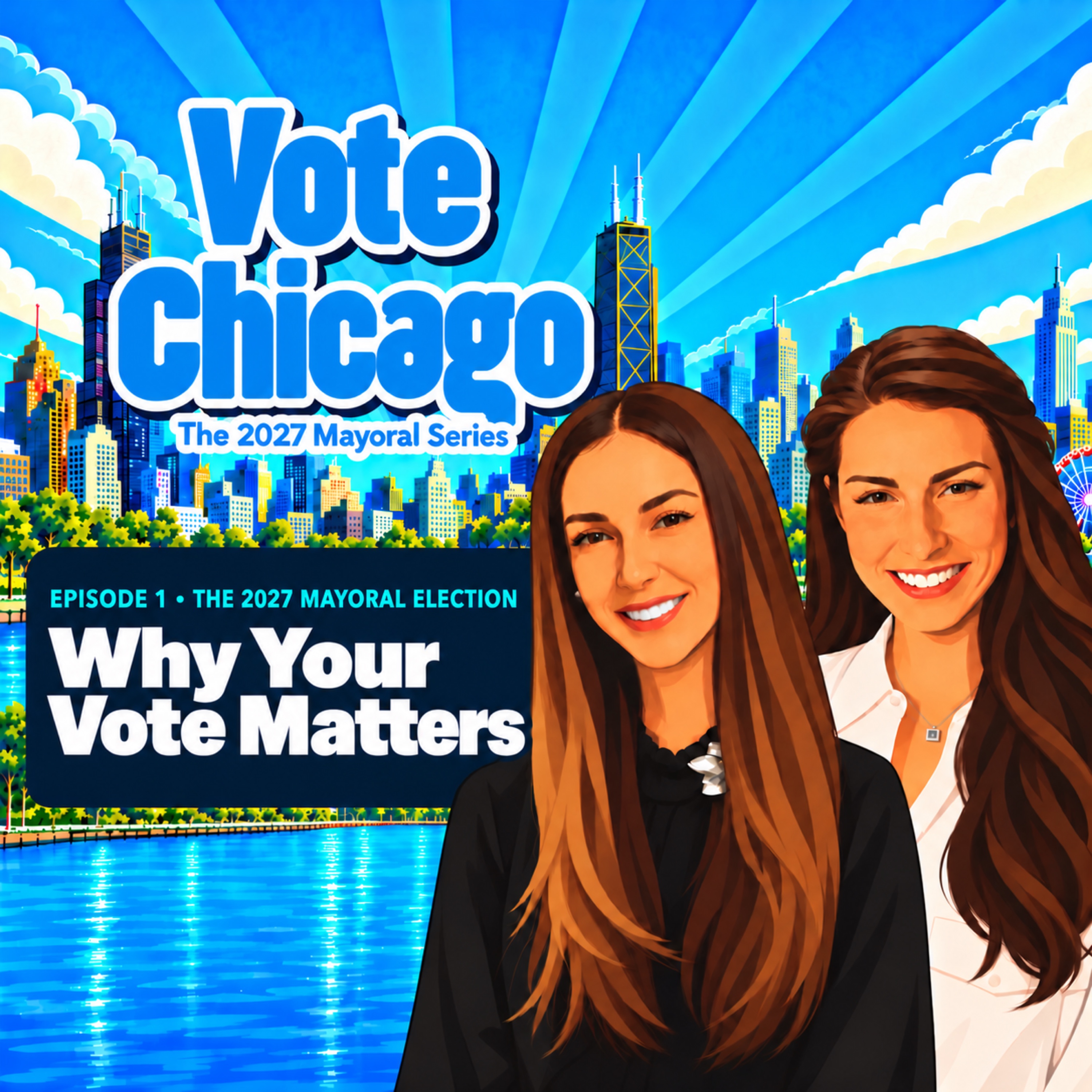
[00:00:00] Speaker A: Welcome to Vote Chicago, an independent, nonpartisan civic guide built for one purpose. To help Chicago voters make a more informed decision in the 2027 mayoral election. Diving deep into the key issues facing Chicago today with experts that know them best, and sitting down with the candidates running for mayor to have direct, structured conversations about their plans for Chicago.
Everything here is designed to make sure you're ready at the ballot box. I'm Jesse Tadoski.
[00:00:30] Speaker B: And I'm Ashley Hart. And we're looking forward to helping you get the information you need to vote Chicago.
This program does not endorse any candidate and is not affiliated with any campaign, political party, government agency, or organization. All candidates we interview have been invited to participate under a standardized format. The views expressed by candidates are solely their own, and this program does not verify their accuracy. This is for informational purposes only. Please see our show notes for the full disclaimer.
Jesse I want to start this whole series with a single number. In 2023, the last time our great city of Chicago chose a mayor, the runoff that decided it, the head to head that put someone in the fifth floor of city hall came down to fewer than four in ten registered voters.
[00:01:16] Speaker A: Seriously, fewer than four in ten.
[00:01:19] Speaker B: Right around 38 to 39% in the last election.
The mayor is of the third largest city in America. A city running a $16.5 billion bigger than a lot of other state governments, got picked by a little over the third of the people who were even registered to weigh in.
[00:01:37] Speaker A: It's crazy, but it does make sense that it happens. The city elections do sort of sneak up on you. There's no presidential race at the top of the ticket pulling everyone to the polls in February. So the coverage is thin. It's a cold February in Chicago, and by the time you're actually paying attention, you're standing in the booth looking at names that you've maybe never heard of before.
[00:01:58] Speaker B: Yeah. And that gap between how the mayor's office shapes your daily life and how little attention the race actually gets, that's the entire reason we're doing this podcast series.
[00:02:08] Speaker A: That's right. So here is the plan for today. We're gonna do three things. First, why we built this series at all, and why your vote in a city election punches so far above its weight. Second, the big one. Here's what's actually at stake for Chicago heading into 2027.
The real challenges the next mayor inherits on day one with the actual numbers, not just the headlines. And third, the practical part, how to get ready, how to vote, and how to be the engaged kind of citizen this city needs a lot more of.
[00:02:39] Speaker B: So let's get into it.
[00:02:41] Speaker A: Okay, so, Ashley, why we're doing this podcast. Let's give people the origin story. Why are two people, one in venture capital, one in real estate, making a civics podcast?
[00:02:51] Speaker B: Because we in this room, kept having the same conversations. And then we kept having those conversations with friends and people all across our network and around dinner tables. And it was clear that everyone cares so much about the city. That's what makes Chicago beautiful, is that we're all in it together and we all have opinions on crime and on taxes and whether our kids school is really good or not. But when it came down to vote for the person who controls so much of that, no one felt informed and we all felt like we were just guessing.
[00:03:22] Speaker A: Yeah. And it's not because people are lazy. It's that the information environment for a city election is kind of poor. National politics, as we know, get wall to wall coverage. Your mayoral race gets a couple debates, some yard signs, but really not much more.
[00:03:37] Speaker B: And that's what really shapes our daily life. And that's the gap that we want to close.
And look, the turnout numbers that we just discussed tell that story.
The 2023 runoff that picked the mayor had 38% of registered voters, but the first round in February was even lower, under 36%.
Go back to 2019, and the runoff that elected Lori Lightfoot only had 33%.
[00:04:02] Speaker A: But before we talk about who's not showing up, it's worth explaining how a Chicago mayoral election actually works, because we do it a little differently than most places.
So the race is officially nonpartisan. There are no party primaries. Every candidate, regardless of party, runs together on a single ballot in late February. This year, it's February 23rd, to be exact. Save
[00:04:24] Speaker B: the date.
[00:04:24] Speaker A: Yeah, keep that date in mind. And to win outright in that first round, you don't just need the most votes. You need an actual majority, more than 50%.
[00:04:32] Speaker B: Which, when you have a ton of candidates in a crowded field, that almost never happens on the first try because everyone splits a vote so that if no one gets to 50% in February, which is typically the case now, the top two finishers advance to a runoff about five weeks later, and that comes in early April.
And whoever wins that election, that's the one that becomes mayor. So that's what happened in 2023 when Brandon Johnson beat Paul Vallis, and then in 2019 when Lori Lightfoot beat Tony Preckwinkle. So there are actually two elections. You have one in February, that narrows the field. And then you've got one in April that determines our actual mayor.
[00:05:09] Speaker A: Right, the runoff. So we're routinely seeing a third of registered voters make a decision that lands on all of us. And it's not really evenly spread either. Turnout for voters skews, older skews towards certain neighborhoods. So the winner of a Chicago election can represent a pretty narrow slice of who actually lives here,
[00:05:27] Speaker B: which is wild because we should think about the leverage that your vote gets. And this is really important in a presidential election, you're one of 150 million-plus votes. Voters in a Chicago runoff that only gets a few hundred thousand ballots, total your vote. And what we Hope are the 10 people you convinced to vote alongside you. That carries real weight. So this is the level where an engaged person can really move the needle.
[00:05:52] Speaker A: Yeah. And that's the case for this series. In one sentence, the race that affects your daily life the most is the one the fewest people are paying attention to.
[00:06:01] Speaker B: And that's what we're hoping to change with this podcast. So. So the podcast is meant to get a conversation going about the leadership the city needs. Our hope is that we all engage and use our information we're learning here and other places to then share with networks each of us have to spur conversation and start a wave of civic engagement.
[00:06:21] Speaker A: That's right. We all love Chicago and we want what's best for our city. So let's engage. We hope some of the start of that for you is through this podcast, but we hope you engage with other informational resources, too.
And after we engage, discuss, and each of us finds a candidate to support, then let's make sure to participate in democracy and use our voices to vote and collectively make an informed decision for Chicago.
[00:06:43] Speaker B: Yep. So let's talk a little bit more about the structure of our limited series that we're bringing to you. The ultimate goal of the series is to inform you on who's running so you get to know the candidates to make the decision that's right for you at the ballot box.
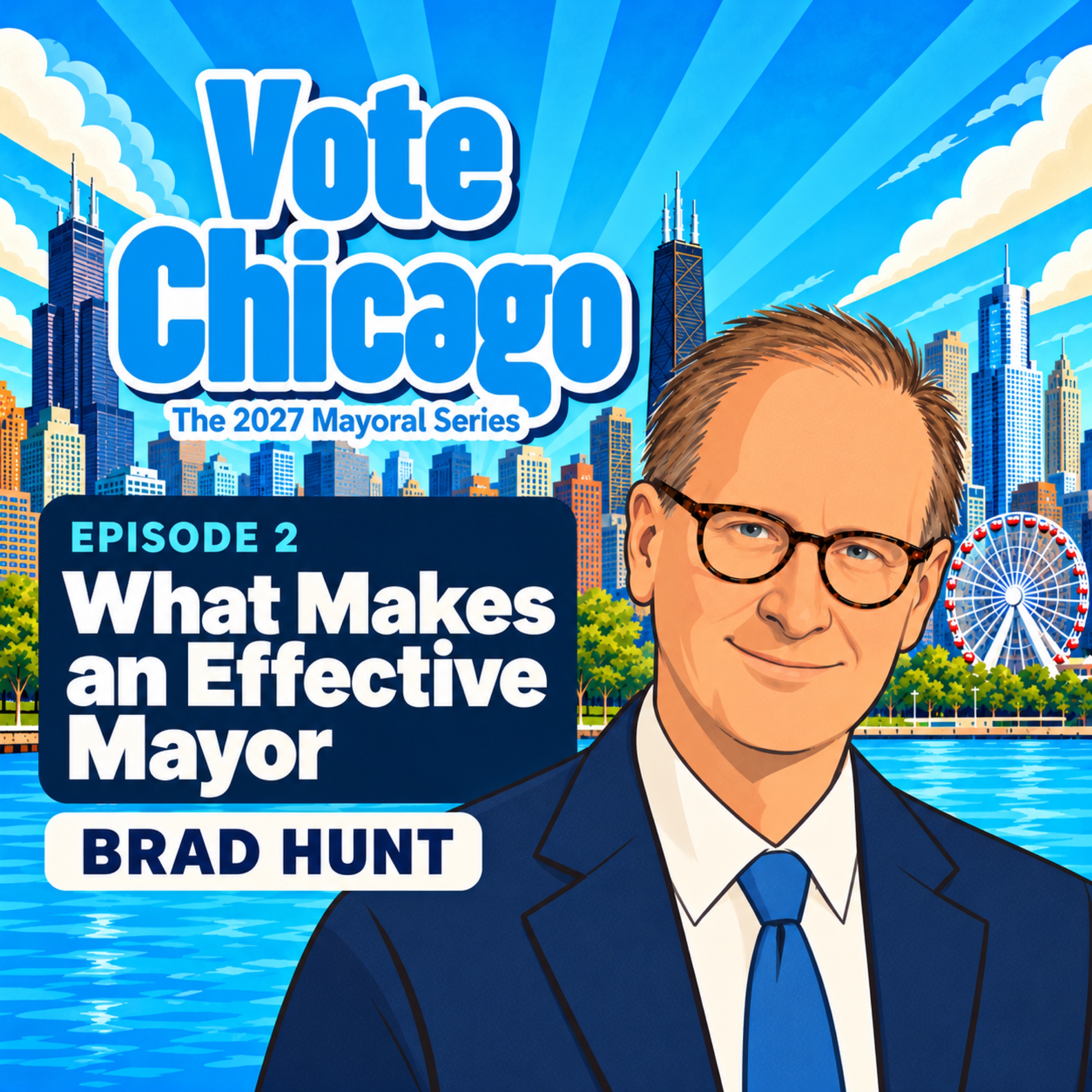
But first, we want to give some context prior to interviewing the candidates to ground us in what's going on in our city. Our second episode is going to be a historical review of the role of mayor in Chicago, namely how the position has changed over the years. Some colorful mayors that have shaped Chicago. And we close out with our thoughts on a loose framework that you could use to guide your evaluation of candidates. This is a fascinating conversation with Brad Hunt, chair of the History Department at Loyola University who has a deep expertise on mayoral leadership. Because it's really important to understand where we've been to know what makes a good mayor for where we're going to go.
[00:07:35] Speaker A: Yeah, of course. And then following that episode, we're going to get down to business, informing ourselves about key issues in Chicago that we should all be considering when listening to mayoral candidate pitches. We will review these issues briefly in this episode, and then in the subsequent episodes, we're going to dive deeper with a true expert on each topic.
[00:07:55] Speaker B: And finally, you'll hear from the candidates directly as they get asked a list of questions, all of which are the same for every candidate in a completely unedited interview. These questions will reference a lot of topics we cover in the earlier episodes. We're inviting every announced candidate to come on our podcast, and we have some really exciting interviews lined up, so you gotta come listen to get to know all the issues and the candidates who are running.
[00:08:18] Speaker A: So let's start here in this episode with just a key overview of. Sorry, an overview of the key issues Chicago's facing. Before we go issue by issue, I think we should start with the frame. It's really easy these days to do a Chicago is doomed episode. We feel like that's lazy, not helpful, and a lot of it isn't even true. We're focused on the true figures, the nuance behind those figures, and ultimately what needs to be done to get our city to excel in a myriad of areas.
[00:08:48] Speaker B: Yes, agreed. So let's start with the one that quietly drives everything else.
The money.
Here is a number that should be tattooed on every candidate's forehead. For 2026, the city was staring down a budget gap of about 1.15 to $1.19 billion. That's a B. And the forecast for 2027, the year the next mayor is campaigning in, is roughly a 1.3 billion dollar budget gap.
[00:09:17] Speaker A: And this isn't a one time Covid thing. It's ongoing. Unfortunately, it's structural. The city keeps spending more than it brings in year after year. And the single biggest driver is pensions.
[00:09:28] Speaker B: Yeah, the city's pension bill alone for 2026 is in the neighborhood of $2.9 billion because of a state mandated schedule to get those funds healthy by the 2050s.
That's not an optional payment. That's a legal obligation that comes off the top before a single pothole gets filled in your street or a single cop gets hired.
[00:09:52] Speaker A: So when a candidate stands up and promises you the moon, new programs, no new taxes, no program cuts. This is the number you hold them to because the current budget already leaned on things like a billion dollar TIF surplus and the proposed head tax on big employers that was ultimately defeated.
Honestly, the fights over those were just brutal.
[00:10:13] Speaker B: The budget gets its own dedicated deep dive in the series because it touches literally everything else we're going to talk about. When you hear we'll fund this, the only question you should be asking is with what?
[00:10:24] Speaker A: Yeah, and it's worth sitting on what that pension number actually does to everything else in the budget. That 2.9 billion comes off the top. So every dollar locked into pensions is a dollar that can't go to police, to trash pickup, to filling potholes, to libraries and mental health clinics. People actually touch. The bigger that obligation gets, the less room there is to fund the basic services that make the city run. Today, pensions and debt service together are nearly 5 billion, which is roughly 40% of the budget and about double of what New York or LA spends as a proportion of their budgets.
[00:10:59] Speaker B: The tempting answer is always just, we'll grow our way out of it. We'll get more residents to come, newer businesses, a bigger tax base, which means the problem will be solved. Right?
But the truth is we likely can't grow our way out of this problem.
Chicago has roughly the same number of people today as it did in 1920. Yes, 1920.
That was
[00:11:19] Speaker A: a long time ago.
[00:11:20] Speaker B: Yeah. We have 2.7 million people now, and we had 2.7 million people in 1920.
We peaked at 3.6 million back in 1950, and we've been drifting down ever since.
[00:11:33] Speaker A: That's right. While we could certainly still benefit from population increases, we have to be honest about the fact that we can't grow our way out of this pension problem. Which means the gap mostly has to close the hard way. Spending cuts, new revenue, maybe even pension negotiations. A much longer conversation and probably a mix of all three of those. And that's the reality every candidate is walking into.
So on the budget episode, we sit down with Austin Berg, who's the executive director of the Chicago Policy Center. And here's a bit of what he says. This is an incredibly informative conversation. And Austin's just a wealth of knowledge. So highly recommend you listen to this one.
[00:12:09] Speaker C: Our biggest problem is not our environment. It's not, you know, a lack of talent, a lack of ingenuity, a lack of infrastructure or universities. It's really just these compounding poor decisions over decades. And that shows up on our balance sheet in the form of debt. Probably the most consequential Mayoral election for the future of the city's finances ever.
[00:12:35] Speaker A: So the issue most top of mind public safety.
Now, recently there's been some positive news. In 2025, Chicago recorded 460 homicides. Now, one homicide is one too many. But the 2025 figure is down about 29% from the year before. And it's the fewest homicides in roughly 60 years.
[00:12:57] Speaker B: And it's important to note that this was the fourth straight year of declining violence, which is great.
Shootings dropped around 35% and carjackings, which terrified everyone, including me, a couple of years ago, were down roughly 50%.
But the other half of that picture is better, isn't solved. We can't rest on our laurels. The city still had over 1,800 shootings in a single year. And the homicide rate is about 14.6 per hundred thousand, which is still several times higher than New York's. The progress is also wildly uneven, block to block, where a handful of neighborhoods carry most of the violence.
[00:13:37] Speaker A: Yeah. So the real question for a candidate isn't are you tough on crime? Everybody will say yes to that. It's what specifically drove this recent drop and what's your plan to keep it going, especially with budget pressure on every department?
[00:13:50] Speaker B: And we're going to go deep on that. In our episode covering key issues, which includes public safety, we have Rosanna Ander, executive director of the University of Chicago Crime Lab, to get us up to speed on safety.
[00:14:03] Speaker D: While there's been progress made, I think there are some very important headwinds that we need to take into consideration and not assume that we're just going to continue without really intentional effort to see the declines continue. So the headwinds are our city and state are flat broke.
The federal government, I think, is unlikely to be coming in with significant new resources, as they did post pandemic.
And I think another even kind of less, I think, appreciated challenge is we are seeing some of the data work that we've done recently. We've uncovered the fact that while overall homicides are going down, and that is the really good news, when there is a shooting incident, it is much more likely to be fatal.
[00:14:48] Speaker A: Okay. So on to housing and affordability. In Chicago, over 40% of households are cost burdened, meaning they're spending more than 30, 30% of their income just on housing.
[00:14:59] Speaker B: Four in 10 households means that it's not a fringe problem. It's the median experience for a huge chunk of our city.
[00:15:06] Speaker A: Yeah. And it's a squeeze from both ends. Home prices are well up over 20% since 2019.
The inventory is really tight, and rents have been climbing. Chicago's had some of the steeper rent increases among big US Markets recently.
Meanwhile, a lot of the new development gets concentrated downtown and on the north side, while huge swaths of of the south and west side see very little development.
[00:15:28] Speaker B: So you've got an affordability crunch and a geography of investment problem happening at the same time.
And both of these run straight through the mayor's desk with zoning permitting and where the city puts its housing dollars. Marisa Novara, former housing Commissioner of Chicago, is coming on to educate us on the nuances of housing,
[00:15:47] Speaker E: a metric on the affordable side. According to the Institute for housing studies at DePaul, we're almost 120,000 units short of the affordable housing that we need in Chicago.
Just to put that in context, when I was housing commissioner, we were funding new and rehabbed affordable units at about 1,200 a year. We were funding about 1,200 new and rehabbed units a year. If you do the math, it's not good math. It would take us 100 years. That's only if we lost no currently existing affordable units, which is not a realistic expectation. Right. So the math doesn't work. That stems back to the national lack of prioritization that is then exacerbated by local decisions.
[00:16:38] Speaker B: Now let's turn to education.
Education is one where the surface number looks fine and the deeper number is the one to worry.
Chicago Public Schools graduation rate is up around 84%, a long climb from where it was.
[00:16:51] Speaker A: Yeah, but graduating isn't the finish line. When you follow CPS students out past high school, the completion picture gets pretty hard. Of 100 students who start at ninth grade, only about 30 finish a college credential within 10 years.
And the gaps by race and gender are just enormous.
[00:17:07] Speaker B: And it starts long before college. That's just, you know, the end game.
On the most recent state report card, only about 4 in 10 CPS kids in third through eighth grade read at grade level, and only about 1 in 4 are proficient in math.
And here's the kicker. That's after the state lowered the bar for what counts as proficient in 2025.
[00:17:30] Speaker A: Wait, they lowered the bar? And most kids still aren't clearing it?
[00:17:34] Speaker B: They did under the tougher standard the year before. It was even Starker. We had 30% in reading and 18% in math.
[00:17:43] Speaker A: Wow. So. And you can see it in the buildings, too. The CPS enrollment's down about 18% from a decade ago. Roughly 71,000 fewer students than in 2014. So a lot of schools are running well under the capacity they were built for. And on top of that, about 40% of students are chronically absent, missing 10% or more of the school year. That's up from around 24% below the pandemic. So. So you've got empty seats in, really two different kids who've left the district completely and kids who are enrolled but just aren't showing up.
[00:18:15] Speaker B: And we can't forget the layer of politics that happens as well. CPS has its own budget crisis. We've got a newly elected school board to figure it out, and we have a tense relationship with the city over who pays for what, including a disputed pension payment that's tangled up in that 2025 deficit we mentioned.
[00:18:33] Speaker A: So the school's question isn't just, do you support good schools? It's how the mayor works with a board they no longer fully control. Because now we'll have this fully elected school board, which is new in Chicago's history.
And how the mayor advocates for what education really looks like in our city.
[00:18:50] Speaker B: Janice Jackson, who's the former CEO of Chicago Public Schools and a true expert, will be here to give us a deep dive in education. It's so worth a listen.
[00:18:58] Speaker F: If I had to pick one indicator that everyone should be paying attention to in this city, it is how many children between 18 and 24 are unemployed and not in school. The reality is that number is almost 50% for African American students drops down to 25% for Latino students and about 18% for their white counterparts. In some communities in the city, that number is 80%.
So if we're really serious about the city being healthy, and we know that the school system contributes to that, are students able to find gainful employment that supports them and eventually a family when they complete school?
[00:19:38] Speaker A: Okay, so let's talk economic development and specifically the tax base, because it connects back to the budget that is so crucially important.
So over the last few years, Chicago has lost some marquee corporate headquarters. Boeing, Citadel, Tyson Foods. They all move their headquarters out.
[00:19:55] Speaker B: And every one of those is more than just a headline. It's jobs, it's civic philanthropy, and it's a signal to other companies about whether Chicago is a place to plant your flag.
Illinois itself has lagged the national average on job growth and runs a higher unemployment rate.
[00:20:11] Speaker A: Yeah, and here's where I want to be fair, because this is exactly where the dying city narrative gets lazy. On population. Chicago's actually growing again. The newest census estimates have the city up for its third straight year at 2.7 million people,
[00:20:24] Speaker B: which does surprise people. But we need to actually read it carefully because the growth is decelerating. We added almost 28,000 people one year and only about 5,300 the next.
And Cook county as a whole has lost something like 84,000 people since 2020, which means that Houston is slowly closing in on our spot as the third largest city in the country.
[00:20:46] Speaker A: Well, we can't have that happen. So the framing isn't everyone's fleeing necessarily, but what the headlines seem to suggest. And how do we encourage more green shoots to slap back on the exodus narrative? The competitiveness question is real important. Do people and companies choose to build their future here? What's the long game? And it's really on the mayor to effectively communicate that. Why Chicago message
[00:21:09] Speaker B: 100%.
We've got Michael Fosnacht, former head of World Business Chicago, who will come speak to us on the topic of economic development.
He's wonderfully candidate,
[00:21:20] Speaker G: but I think we lost a bit of a growth mindset. We cannot cost cut our way to a prosperous great future. We need to grow and be fiscally responsible.
[00:21:33] Speaker A: So that's the board of topics. Budget pressure underneath everything, progress on safety that no one wants to lose, an affordability squeeze, schools that graduate kids but struggle to launch them, and a competitiveness question that decides the next decade.
[00:21:49] Speaker B: And notice the through line. Almost every one of these comes back to two money and trade offs. Which is exactly why we're going to keep asking every expert and every candidate the same blunt question.
Sounds great, but how do you pay for it and what do you give up?
Okay, so we made the case that this matters, I hope, and we laid out the stakes. Now let's make it practical. Jesse, if someone's thinking, listening in and they're thinking, all right, I'm in, what do they do?
[00:22:19] Speaker A: Okay, so there's three things and none of them are hard. First, do a little homework and let us do most of it for you. That's literally what this series is. We're going to break down each issue with experts, then sit down with the candidates and ask them the same structured questions so you can compare them apples to apples instead of who had the best ad or the nicest smile.
[00:22:39] Speaker B: And second, we're encouraging you to talk to people. This is the one that moves elections at a city level. Civic engagement isn't just you voting. It's you being the person in your group chat, your building, your block, who says, hey, there's an election coming up. Here's what's at stake. Here's what I think about it. What about you?
Turnout this low means a handful of motivated people can swing outcomes. For example, Currenton Johnson won the Chicago mayoral runoff by a 4% margin in the final count. That's 26,000 votes. Not a lot.
To cite an even closer match, State's Attorney Eileen O' Neil Burke won by a mere 1,500 votes in a county primary of over 500,000 votes. Cast whatever side of the votes you were on, that's not many people to swing that decision. Your vote counted.
[00:23:32] Speaker A: Yeah. Really, Every vote counts. And let's not underestimate that. If everyone listening just brought five people along, that's not a rounding error in a Chicago election. It's a movement. So let's start a civic engagement movement.
[00:23:46] Speaker B: I love that.
Third, and this is the concrete one, make a plan to vote before election day.
The single biggest reason good intentions don't match votes is friction.
I get it. Life gets busy, the day arrives, you can't get away from work. There's so many reasons.
[00:24:03] Speaker A: Yeah. So take the friction out now. The easiest move for a lot of people is just vote by mail. You can request a ballot online from the Chicago Board of Elections literally right now. And then going forward, for every future election, they mail it to where you live, you fill it out on your own time, and you send it back. No taking off work, no wants.
[00:24:21] Speaker B: And spoiler alert, that's what I do. And it's a huge help.
So we'll put the direct mail and ballot link right in the show notes. And if you do one thing after this episode, do that. Request the ballot while you're thinking about it so that future you can be grateful.
[00:24:35] Speaker A: Yeah. And you know what? Some people like to vote in person. If you'd rather vote in person, great. Just know your early voting options and know your polling places ahead of time. The whole game is decide how you're voting before the moment you have to go vote,
[00:24:48] Speaker B: research, recruit, and remove friction. That's it. That's the whole playbook.
[00:24:53] Speaker A: So that's the lay of the land for the Vote Chicago series. We've given you the thought behind the podcast, the issues we're going to cover, the structure of how we're going to cover them, and what you can do to help us make this a civic engagement movement.
[00:25:05] Speaker B: As we've discussed, the mayor's race is the election that shapes your daily life the most. And it's the one the fewest people show up for. Those two facts don't have to stay true at the same time. That's on all of us.
[00:25:19] Speaker A: I'm Jesse Dadosky.
[00:25:21] Speaker B: And I'm Ashley Hartman. Thank you so much for being here. We're excited for you to be part of our series. Go request that ballot and we'll see you next episode.
Vote Chicago 2027 is an independent publication and podcast. This program is not affiliated with, sponsored by, endorsed by, or connected to any political campaign, political party, political action committee, super pac, government agency, or any other organization. Any similarity in name to any other organization is not intended to imply any affiliation, endorsement or connection. This program does not endorse, support, oppose or recommend any candidate for the 2027 mayoral election or any other public office. The publication of a candidate's interview does not constitute an endorsement of that candidate. A candidate's participation does not constitute their endorsement of this program. All declared and qualified candidates for the 2027 Chicago mayoral election have been or will be invited to participate.
Interviews are conducted using a standardized format to ensure fairness and equal treatment. If a candidate has not yet appeared, the invitation remains open. The views, opinions, claims and statements expressed by candidates are solely their own. This program does not verify, fact check or vouch for the accuracy, truthfulness or completeness of any candidate's statements. Listeners and readers are encouraged to conduct their own research and consult multiple sources before making voting decisions. This program is produced for informational, educational purposes only. Nothing herein constitutes political advice, legal advice, financial advice, or recommendation to take or refrain from taking any action. The copyright for this program is held by 2026 Chicago Syndico, LLC. All rights reserved. All content, including text, video, audio, graphics and logos, is the property of the producer and is protected by US International copyright laws. Unauthorized reproduction, distribution or use is prohibited without prior written consent to the fullest extent permitted by law. This program, its producers, hosts, employees, agents and affiliates should not be liable for any direct, indirect, incidental, consequential, special or punitive damages arising out of any or related to the use of this website, podcast, or any content therein, including any reliance on statements made by candidates. This disclaimer Any disputes arising from the use of this website or podcast shall be governed by the State of Illinois. Exclusive jurisdiction and venue shall lie in the State or federal courts located in Cook County, Illinois. For more information about voter registration, polling locations and how to participate in the 2027 Chicago mayoral election, please contact the Chicago Board of election
[email protected] for questions, concerns or legal inquiries, please contact votechicagousubstack.com.